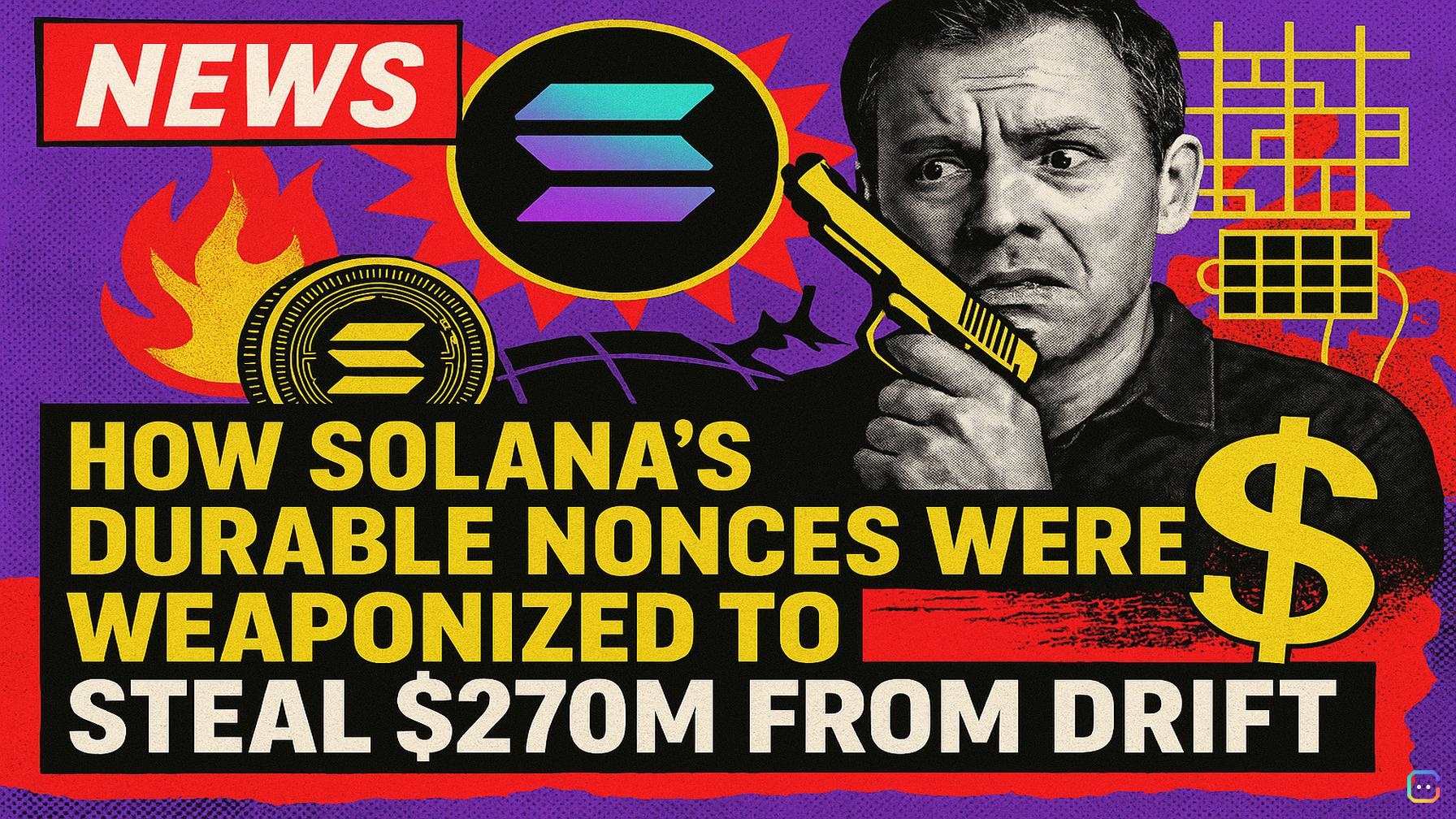
Headline: A Solana convenience feature turned weapon — how pre-signed “durable nonces” let attackers siphon $270M from Drift
Summary
An attacker drained at least $270 million from Drift in an exploit that wasn’t a traditional code bug, private-key compromise, flash loan, or oracle manipulation. Instead, the attacker abused a legitimate Solana feature called durable nonces to get two Security Council multisig members to pre-approve transactions that could be executed weeks later — and then triggered those transactions in under a minute.
What durable nonces are (and why they matter)
On Solana each transaction normally includes a recent blockhash that expires after ~60–90 seconds, preventing old transactions from being replayed. Durable nonces override this safety: they replace the expiring blockhash with a persistent nonce stored onchain, allowing a transaction to remain valid until someone submits it. This is useful for hardware wallets, offline signing, and institutional workflows that need time between signing and submission — but it also lets approvals be separated from execution by days, weeks, or longer.
How the attacker used that gap
Drift’s protocol governance relied on a Security Council multisig (five members, two signatures required). According to Drift, the attacker obtained what they call “unauthorized or misrepresented transaction approvals” from two separate council members — meaning the signers likely believed they were approving routine actions. Because these approvals were embedded into durable-nonce transactions, the attacker could hold the valid signatures indefinitely and submit the transactions later in a context those signers never intended.
Timeline (as published by Drift)
- March 23: Four durable nonce accounts are created. Two tie to legitimate Security Council members; two are controlled by the attacker. This indicates the attacker already had two-of-five approvals locked into durable nonce transactions.
- March 27: Drift performs a planned Security Council migration. The attacker adapts to the new configuration.
- March 30: A new durable nonce account appears linked to a member of the updated multisig, showing the attacker again obtained two-of-five approvals under the new setup.
- April 1: Execution day. Drift runs a legitimate test withdrawal from its insurance fund. About one minute later the attacker submits the pre-signed durable-nonce transactions. Two transactions, four Solana slots apart, were sufficient to create and authorize a malicious admin transfer and then execute it. Within minutes the attacker controlled protocol-level permissions and introduced a fraudulent withdrawal mechanism that drained the vaults.
The loot and the trail
Onchain researchers — with a compiled breakdown by Vladimir S. — traced roughly $270 million taken across dozens of tokens. Major totals include:
- $155.6 million in JPL
- $60.4 million in USDC
- $11.3 million in CBBTC (Coinbase-wrapped BTC)
- $5.65 million in USDT
- $4.7 million in wrapped ETH
- $4.5 million in DSOL
- $4.4 million in WBTC
- $4.1 million in FARTCOIN
Plus smaller amounts in JUP, JITOSOL, MSOL, BSOL, EURC and others.
Key operational traces:
- The primary drainer wallet was funded eight days before the attack (via NEAR intents) and remained dormant until execution day.
- Stolen funds moved through intermediary wallets, some of which were funded the day before via Backpack — a dApp that requires identity verification — potentially a trace for investigators.
- Funds were bridged to Ethereum via Wormhole. The receiving Ethereum addresses had been pre-funded using Tornado Cash.
- Investigators (including ZachXBT) noted that over $230 million in USDC was moved from Solana to Ethereum via Circle’s CCTP across more than 100 transactions. ZachXBT criticized Circle for not freezing the funds during a roughly six-hour window after the attack began (around noon ET).
Operational failure, not a code flaw
Security researchers and onchain investigators characterized this as another major incident driven by social engineering and operational-security lapses rather than smart-contract bugs. A social-media investigator summarized the pattern: similar outcomes — massive losses — have resulted from compromised signing infrastructure or tricked signers in prior incidents (Bybit, Ronin, Cetus among them). The core vulnerability was the human layer around the multisig: durable nonces allowed approvals to be separated from execution time, so the context changed and signers could not revoke approvals unless a nonce account was manually advanced (something most operators don’t routinely monitor).
Immediate fallout and response
- Drift’s protocol has been frozen and the compromised wallet removed from the multisig.
- Insurance fund assets are being withdrawn and safeguarded.
- All deposits into Drift’s borrow-and-lend products, vaults, and trading funds are impacted. DSOL tokens not deposited in Drift (including assets staked to the Drift validator) are not affected.
- Drift says it will publish a detailed postmortem; outstanding questions include how two multisig members approved transactions they did not understand and whether UX/tools could have flagged durable-nonce approvals for higher scrutiny.
Why this matters for DeFi
Durable nonces are a legitimate, useful Solana feature. But they can be weaponized when combined with social engineering and weak multisig operational hygiene. Defending against this vector is hard without changing how multisig approvals work on Solana or improving signer tooling and education so that long-lived approvals are visibly and explicitly handled differently.
Bottom line
This exploit is a reminder that DeFi risk is increasingly about people and processes as much as code. Even sound protocol contracts and multisig setups can be undermined when approval workflows let attackers separate signing from execution — especially when those signatures are locked into transactions that never expire. Expect broader scrutiny of durable-nonce workflows, multisig UX, and custodial signing practices across Solana projects going forward.
Read more AI-generated news on: undefined/news