Microsoft just flipped the script on AI research agents — and the result could matter as much to crypto teams doing due diligence as it does to corporate R&D.
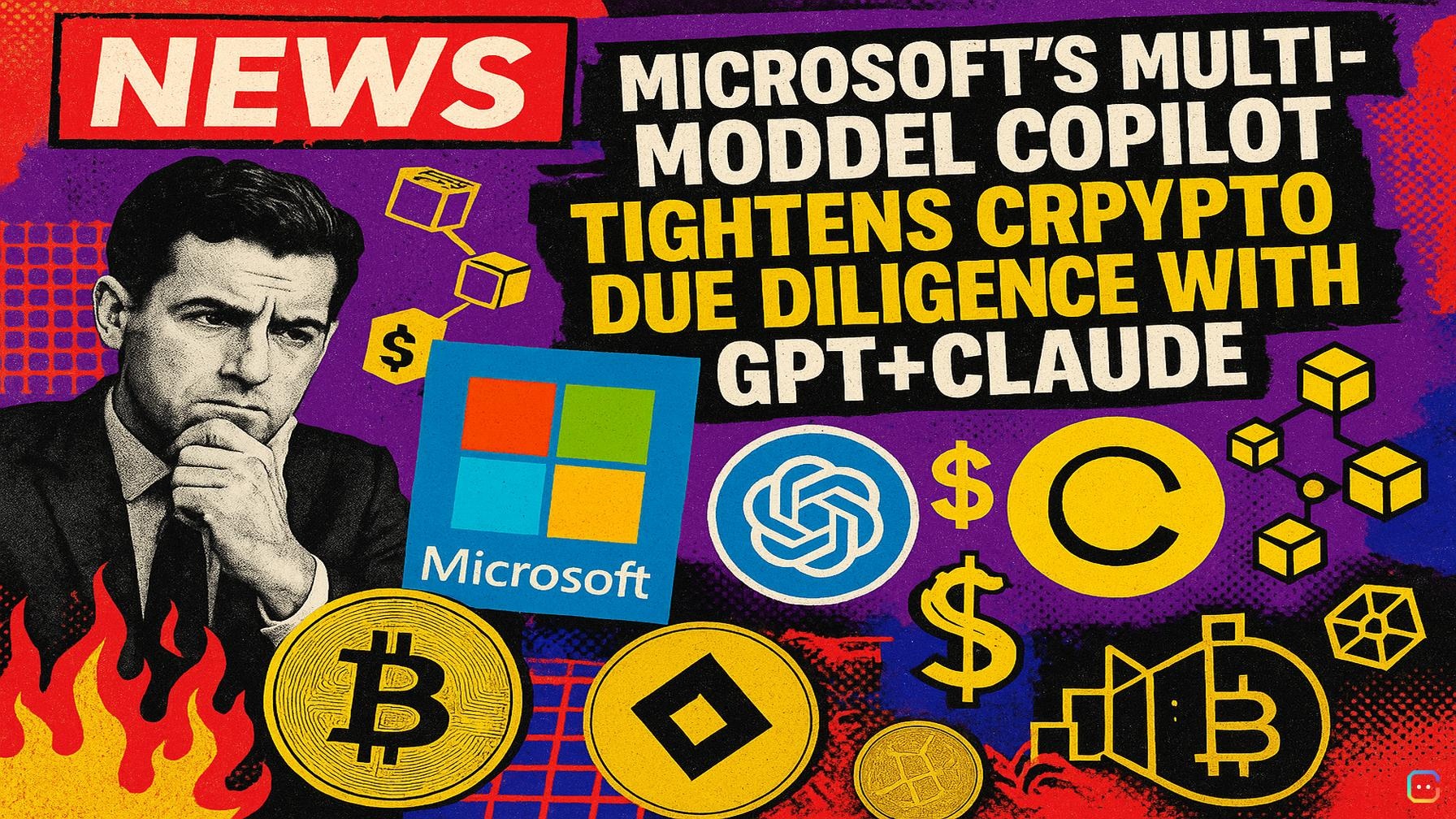
Instead of pitching one model as “the smartest researcher,” Microsoft announced two new Researcher features for M365 Copilot on March 30, 2026 — Critique and Council — that make different AIs work together on the same task. The payoff: in internal testing, the multi-model approach outscored every system in an industry benchmark.
Why it matters
- Crypto projects, auditors, token analysts and DAO researchers depend on fast, accurate synthesis of technical, legal and market sources. Most research agents today use a single model to plan, collect and write answers — which can leave unchecked errors, weak citations or hallucinations. Microsoft’s approach splits and cross-checks those duties, helping reduce the kinds of mistakes that can be costly in crypto (misstated facts, bad source links, flawed smart-contract summaries).
How Critique works
- Critique is a two-step pipeline that separates generation from evaluation. In Microsoft’s demo, OpenAI’s GPT handles the first phase: it plans the task, retrieves sources and drafts the report. Anthropic’s Claude then acts as a specialist editor, reviewing factual accuracy, citation quality and whether the draft actually answers the question. Only after Claude’s vetting does the final report go to the user.
- Microsoft says the roles can be swapped (Claude drafting and GPT critiquing), but GPT currently leads the generation phase.
- The company calls Critique a “multi-model deep research system” that combines models from frontier labs to improve complex research outcomes.
How Council differs
- Council runs GPT and Claude in parallel and produces both full reports side-by-side. A third “judge” model reads both outputs and generates a summary that highlights agreements, divergences and unique angles each model surfaced.
- Think of Critique as collaboration and Council as a structured competition with an adjudicator.
The results
- On the DRACO benchmark (100 complex research tasks across domains such as medicine, law and technology), Copilot with Critique scored 57.4 points. Claude Opus 4.6 alone scored 42.7. Microsoft’s combined system beat the next best result by nearly 14%, with the biggest gains in breadth of analysis and presentation quality and notable improvements in factual accuracy.
Availability and cost
- Both features are available now to users enrolled in Microsoft’s Frontier program (the early-access channel for Copilot). You also need a Microsoft 365 Copilot license ($30/user/month) to access them.
Bigger picture
- The move underscores Microsoft’s bet that the real value is orchestration — routing tasks across multiple best-of-breed models — rather than declaring one model the winner. Microsoft already has deep ties with OpenAI, and this shows it’s willing to stitch together different vendors’ models to boost outcome quality.
- For crypto-focused teams, multi-model research could make on-chain analysis, tokenomics reviews, regulatory summaries and smart-contract writeups more reliable. It’s not a magic bullet — adversarial or domain-specific errors still require human oversight — but it is a meaningful step toward more rigorous AI-assisted due diligence.
Satya Nadella framed the change succinctly: Microsoft’s Researcher is moving from “pick one” to “combine the best,” and the early benchmark gains suggest that, for high-stakes research tasks, that orchestration approach wins.
Read more AI-generated news on: undefined/news