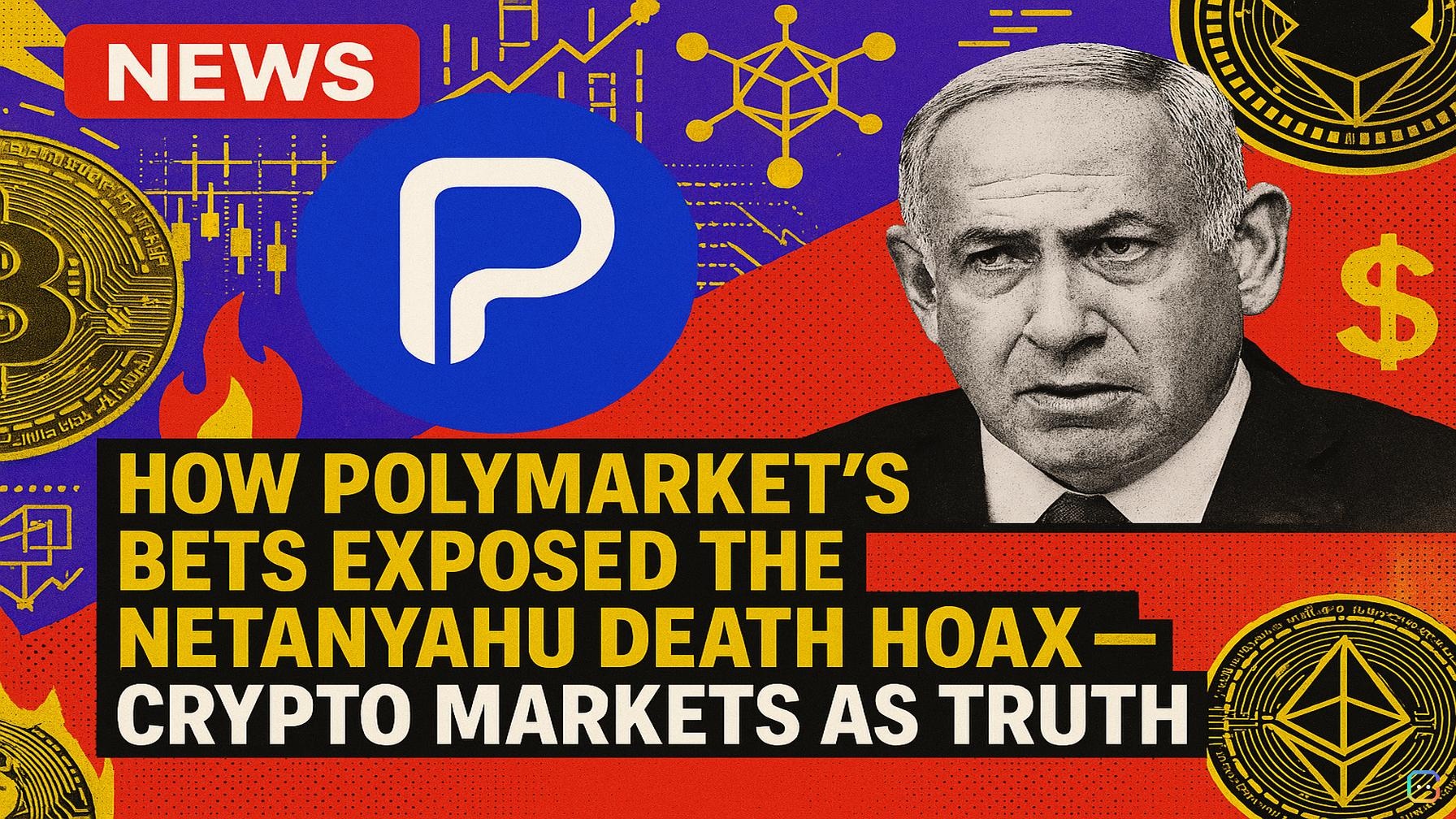
When social media erupted with claims that Benjamin Netanyahu had been killed, the internet followed a familiar wartime playbook: a bold strike claim from Iran’s Islamic Revolutionary Guard Corps, forged screenshots purporting to show the Israeli prime minister’s account posting he was dead, and a dust-up over a grainy freeze-frame that some said showed six fingers on his right hand. Influencers amplified the chatter, Iran’s Tasnim News Agency published a deep-dive alleging a debunk clip was itself AI-generated, and every rebuttal was reframed as part of the cover‑up.
But while podcasts and fact‑checkers chased fragments of video and screenshots, one real‑time data source cut through the noise: Polymarket, the crypto prediction market. Its contract for “Netanyahu out by March 31” was trading at roughly 4–5 cents — implying only a 4–5% chance he would be out of office by the end of the month. That price barely budged during the frenzy. For anyone watching the market, the conspiracy unraveled in a single glance.
Why Polymarket mattered
Prediction markets like Polymarket don’t sell “death” contracts. Instead they offer event contracts — for example, whether a politician will be out of office by a certain date — which resolve “Yes” if the leader resigns, is removed, or a credible source confirms their departure. The logic is simple: a truly dead or incapacitated leader will eventually produce verifiable evidence — a resignation, removal, or leak. If such confirmation appears, a “Yes” share bought at 5 cents would pay $1, a 20‑to‑1 return. If no credible confirmation surfaces, the market stays low.
That pricing mechanism is precisely why the Netanyahu rumor collapsed. During the hysteria the loudest online voices treated the absence of incontrovertible proof as proof of a cover‑up. The market treated that absence as a very low probability. The difference is material: pushing a narrative online is free; putting real money behind it is not. At the episode’s peak, a single Polymarket account bet $151,000 on Netanyahu being out before March 31, buying roughly 3.8 million shares at 4.7 cents. If he had left office, that stake would have paid $3.8 million; instead the position is only about $26,000 underwater — a ceiling on how far rational conviction in the conspiracy went.
Polymarket’s rise and the stakes for markets
The Netanyahu moment arrived at the peak of a dramatic transformation for Polymarket. Since U.S. and Israeli strikes on Iran began on Feb. 28, the platform looked less like a niche crypto project and more like a live geopolitical intelligence feed. In the week ending March 1, users placed $425 million in geopolitics wagers on Polymarket — up from $163 million the prior week — and the platform hit a record $2.4 billion in total wagering. The “US strikes Iran by…?” market alone recorded $529 million in volume.
That growth is staggering compared with 2023, when Polymarket processed $73 million in total trading volume. By 2025 the platform reported about $22 billion in notional trading. The mainstream financial world took notice: in October 2025, Intercontinental Exchange (parent of the NYSE) invested $2 billion at a $9 billion valuation and debuted a “Polymarket Signals and Sentiment” feed to Wall Street trading desks. When traditional markets were closed for a weekend of strikes, Polymarket was live.
Markets as a truth signal — and their limits
Academic and industry observers point to two reasons prediction markets can cut through propaganda. First, they tie outcomes to verifiable resolution rules rather than narratives. Rutgers statistician Harry Crane put it plainly: these markets “anchor outcomes to verifiable sources,” making price movements harder to manipulate with spin alone. Second, arbitrage and profit-seeking behavior tend to synchronize prices across platforms such as Kalshi, Betfair, and others, driving them toward a consensus that reflects real-world probability.
The Netanyahu case contrasted sharply with another recent test. When Iranian state TV confirmed Supreme Leader Ali Khamenei’s death on Feb. 28, Polymarket’s “Khamenei out by March 31” contract spiked to 100% and saw $45 million in volume; the top trader earned $757,000, and several others cleared six figures. That outcome behaved like an efficient market: uncertainty rose as tensions built, then collapsed to certainty as credible confirmation appeared.
But markets are not omniscient. Crane and active traders caution about the resolution rules that define contracts. Polymarket’s “out by” markets resolve based on official announcements or a consensus of credible reporting. If a government managed a perfect, permanent cover‑up — silencing officials, media, fact‑checkers and social accounts — the contract could correctly resolve “No” under its rules even if the leader were actually dead. That’s an important limitation: the market prices the probability of verifiable departure, not the metaphysical truth of an event if it can be entirely hidden.
That nuance helps explain why some traders didn’t rush to buy “Yes.” Well‑known market participant Domer (aka ImJustKen) publicly held a “No” position on the Netanyahu market not because he was certain Netanyahu was alive, but because he believed the market would only resolve “Yes” if independent confirmation emerged. He was pricing the verification gap, not endorsing conspiracy.
Manipulation, wash trading and regulatory pressure
Prediction markets are not immune to manipulation or noise. Historical data shows wash trading — self‑dealing activity that inflates volume — has been meaningful on Polymarket: researchers have attributed roughly 25% of historical volume to it, with a peak near 60% in December 2024 before falling. Wash trading bloats headlines but doesn’t automatically bias prices; still, it’s a legitimate caveat to the “wisdom of crowds” story.
Smaller markets with limited liquidity are more vulnerable to coordinated campaigns, and political attention on these platforms is rising. Kalshi, Polymarket’s CFTC‑regulated U.S. rival, invoked a “death carveout” to settle Khamenei positions at the last traded price before confirmation (about 39.5 cents) rather than paying out the full dollar — a decision that triggered a $54 million class action lawsuit. Kalshi says it followed its rules and reimbursed users for fees and net losses, while critics point to inconsistent applications of the carveout (Kalshi settled a previous market on former President Jimmy Carter differently when he died).
Regulators and politicians are taking aim. Six Democratic senators, led by Adam Schiff, asked the CFTC to ban contracts that “resolve upon or closely correlate to an individual’s death.” Senators Jeff Merkley and Amy Klobuchar introduced the End Prediction Market Corruption Act, which would bar senior federal officials and their families from trading event contracts and impose fines and clawbacks. Blockchain analytics firm Bubblemaps flagged six new wallets that collectively netted $1.2 million on bets tied to U.S. strikes on Iran; one trader reportedly turned about $60,000 into nearly $500,000 — detail that fuels concerns over insider trading and timely information flows.
Legal lines of fire are complex. Polymarket itself was pushed offshore after a 2021 CFTC settlement that barred U.S. users from accessing it directly; that remains its largest legal exposure. Some observers — including attorney Aaron Brogan — argue much of the current Congressional attention is political theater unless a major market collapse or scandal forces change. State-level enforcement is also heating up: Arizona has charged Kalshi with operating an illegal gambling operation, raising questions about federal preemption of state law.
What this episode shows
The Netanyahu conspiracy showed how prediction markets can act as a fast, market‑priced reality check in an era of viral misinformation. When social feeds said certainty, the market said low odds. When plain confirmation appeared in the Khamenei case, the market moved to certainty and paid out; when no verifiable confirmation appeared for Netanyahu, the market stayed near pennies.
That’s not to claim markets are perfect. They are bounded by contract terms, by the quality of public sources, by liquidity and by the possibility of manipulation. But the core insight is powerful: putting money on the line forces a different kind of accountability than likes, retweets and viral outrage. In the Netanyahu episode, the crowd’s pocketbook — more than punditry — gave the clearest, quickest answer.
When influencer Candace Owens demanded to know “where Bibi was,” Polymarket had already priced the answer. It cost only a few cents to read it.
Read more AI-generated news on: undefined/news