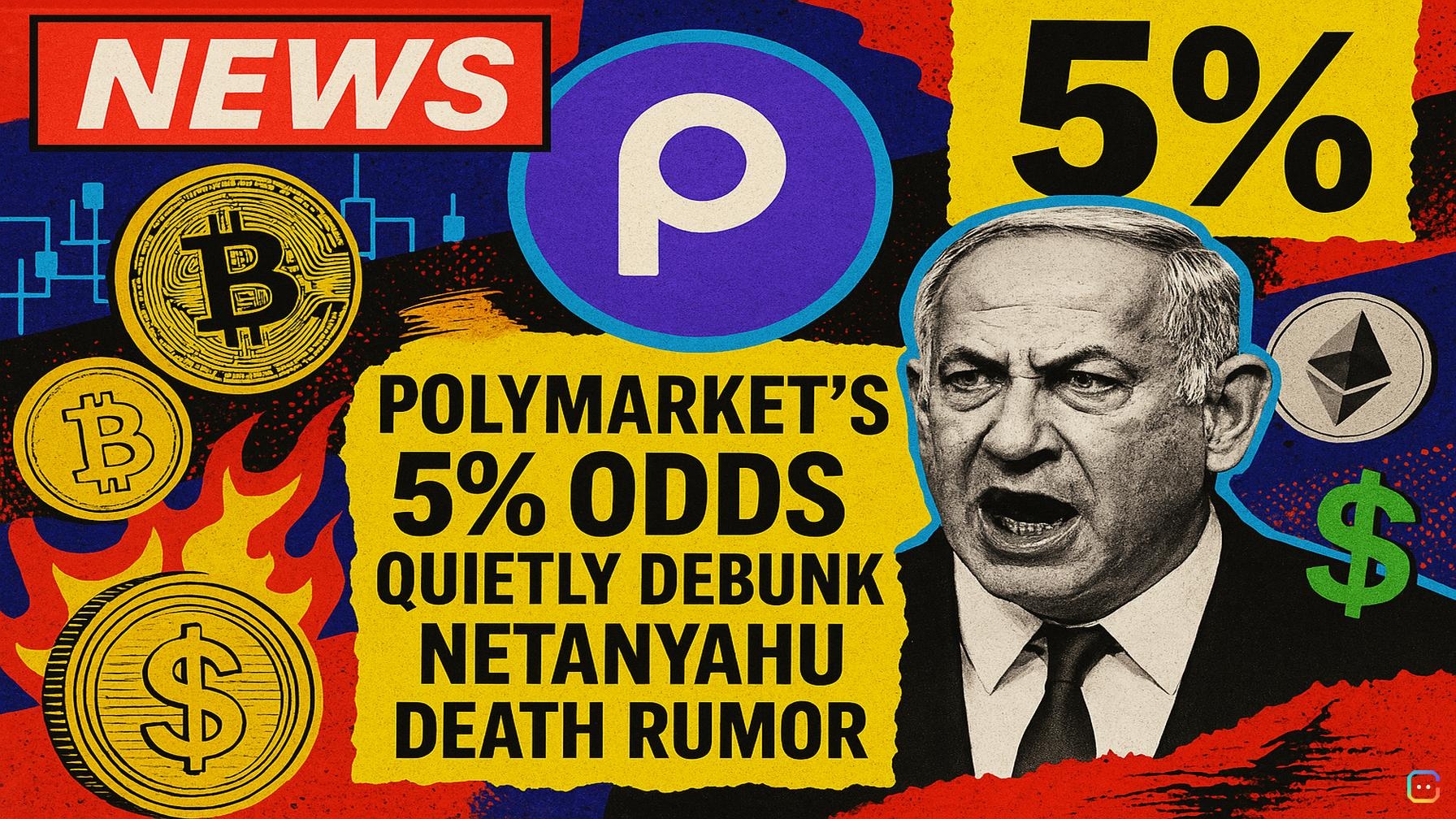
When a viral rumor claimed Israeli Prime Minister Benjamin Netanyahu had been killed and his team was staging a cover-up, the online chaos played out like a textbook information war: bold claims, doctored screenshots, low-res freeze-frames hyped as “AI proof,” and influencers amplifying the story. But amid the noise, one market quietly told a very different story — and it did so with real money on the line.
Polymarket, the crypto prediction market that’s become a go‑to for real-time geopolitical signals, had a simple data point: the contract “Netanyahu out by March 31” was trading around 4–5 cents. That implied only a roughly 4–5% chance he would leave office by the end of the month. The price didn’t budge as the conspiracy spread. For anyone watching that quote, the rumor collapsed at a glance.
Why a prediction market? After the US and Israel struck Iran on Feb. 28, Polymarket morphed into something resembling a live intelligence terminal. In the week through March 1, traders put $425 million into geopolitics markets on the platform — up sharply from $163 million the week before — and platform wagering hit a record $2.4 billion. A single contract, “US strikes Iran by…?”, amassed $529 million in volume, ranking among Polymarket’s largest-ever markets.
Polymarket’s growth has been meteoric. From $73 million in total trading volume in 2023 and a CFTC settlement that pushed it offshore, the platform processed roughly $22 billion in notional volume in 2025. Institutional interest followed: in October 2025 Intercontinental Exchange (ICE), owner of the NYSE, invested $2 billion in Polymarket at a $9 billion valuation and rolled out "Polymarket Signals and Sentiment" to feed prediction-market data to Wall Street desks. Crucially, when traditional markets were closed over the weekend of the Iran strikes, Polymarket was still trading.
Polymarket doesn’t sell “death” bets. Its political contracts resolve “Yes” if a leader resigns, is removed, or steps down — all confirmed by official or credible reporting. But in practice, those contracts act as a proxy for more extreme claims: if a head of government were truly dead and the government tried to conceal it, eventually a resignation, removal, leak or definitive confirmation would surface and the market would pay out. That means a low price on “out” is a strong signal against the rumor of a hidden death.
The market also quantifies how far believers in a claim will put their money. One Polymarket account placed $151,000 on Netanyahu exiting before March 31, buying nearly 3.8 million shares at about 4.7 cents each — a position that would have paid $3.8 million if it resolved “Yes.” That wager, however bold, was underwater by roughly $26,000 as the price held around 5 cents. In other words: at the height of online hysteria the most aggressive speculator was willing to risk six figures — and still not move the market’s consensus beyond a few percent.
Experts point out why markets like this often cut through propaganda. Traders arbitrage across platforms (Polymarket versus Kalshi, Betfair, etc.), and profit-seeking behavior tends to remove persistent mispricing. As Flip Pidot and Rutgers statistician Harry Crane have argued, efficient markets anchor to verifiable criteria rather than narratives. That anchoring showed up starkly in a recent contrast: when Iranian Supreme Leader Ali Khamenei was confirmed killed in the Feb. 28 strikes, Polymarket’s “Khamenei out by March 31” contract jumped from mid-range odds straight to 100% on state confirmation, producing $45 million in volume and large payouts for winning traders. The Netanyahu market never behaved that way — it stayed below 5 cents throughout the rumors.
Not all platforms handle such events the same. Kalshi, a CFTC-regulated rival, applied a “death carveout” to its Khamenei market and settled at about 39.5 cents rather than paying the full dollar — a decision that triggered a $54 million class action. Kalshi says it followed its rules and reimbursed users for fees and net losses; critics say the carveout was selectively applied. Those inconsistencies have fueled regulatory scrutiny: six Democratic senators, led by Adam Schiff, have asked the CFTC to ban contracts that “resolve upon or closely correlate to an individual’s death,” while senators Merkley and Klobuchar proposed the End Prediction Market Corruption Act to ban senior officials and families from trading event contracts and impose penalties for misconduct.
Blockchain analytics firm Bubblemaps has also flagged potential market timing issues: six new wallets collectively netted $1.2 million betting on the timing of US strikes, and one trader turned roughly $60,000 into nearly $500,000. Those trades — and broader concerns about wash trading (estimated to account for a sizable share of Polymarket’s historical volume at times) — underscore that prediction markets are not infallible. Wash trading inflates headline volume without necessarily changing prices, but it remains a real caveat.
There’s a deeper conceptual limit, too. Polymarket resolves against credible confirmation. If a regime could hide a leader’s death so completely that no credible source ever confirmed it, a contract might correctly resolve “No” even if the leader were dead — because the market’s rules demand public verification. Some traders, like the noted market participant ImJustKen, explicitly bet on that verification gap rather than the underlying reality.
That distinction is crucial. The Netanyahu rumor only holds together if you assume a cover-up so total that independent media, fact-checkers, international officials and the leader’s own social accounts are all complicit and silent. Such an unfalsifiable claim is exactly the sort of thing rational traders are unlikely to bet on — which is why the market priced the scenario at a few cents.
Whether lawmakers will curb these markets is uncertain. Legal pressures differ by platform: Kalshi faces state and federal challenges, including an Arizona gambling charge, while Polymarket operates largely offshore after its settlement with the CFTC. Critics warn of potential manipulation and political risk; defenders argue prediction markets provide valuable, verifiable signals that counter propaganda.
In this episode, the market did its job: while influencers demanded proof and conspiracies multiplied, Polymarket’s quote offered a clear, immediate answer — and it cost only a few cents to read.
Read more AI-generated news on: undefined/news