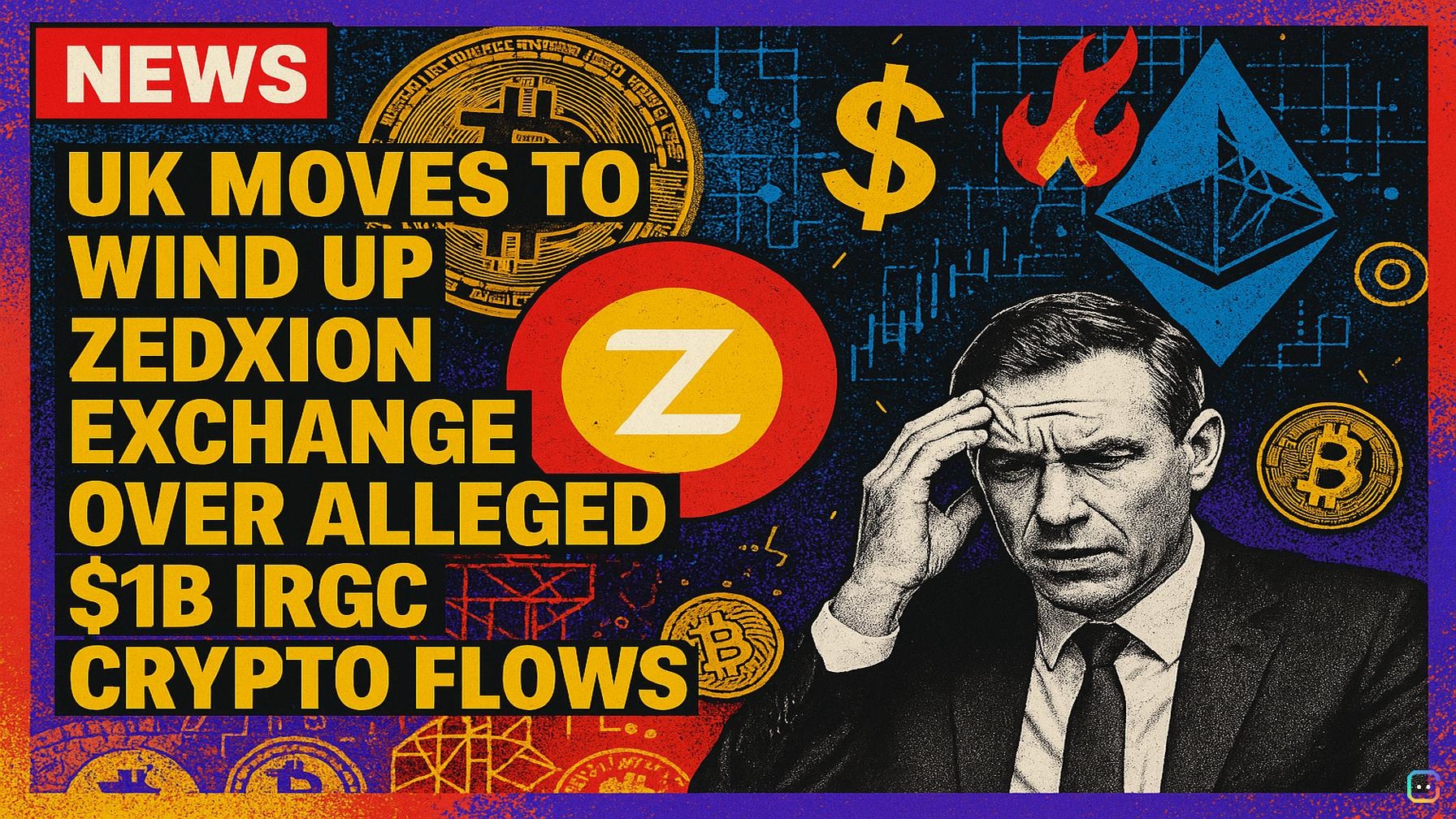
Britain’s corporate regulator has moved to wind up a cryptocurrency exchange accused of acting as a financial conduit for Iran’s Islamic Revolutionary Guard Corps (IRGC), marking a high-profile enforcement action tied to U.S. sanctions and growing scrutiny of crypto-enabled sanctions evasion.
What happened
- Companies House has begun proceedings to dissolve Zedxion Exchange Ltd., saying information submitted when the firm was incorporated was “misleading, false or deceptive.” The action follows U.S. Treasury sanctions in January from the Office of Foreign Assets Control (OFAC), which designated Zedxion and a sister platform, Zedcex, for allegedly enabling Iran to dodge sanctions and for links to sanctioned financier Babak Zanjani.
- Investigations by reporters and blockchain analytics firms uncovered apparent fakery in the company’s filings: a listed director and person with significant control, “Elizabeth Newman,” was likely a fictional identity (promotional material used a stock photo), and an earlier listed controller, “Babak Morteza,” appears to match identifying details for Babak Zanjani.
Money flows and links to the IRGC
- Blockchain analytics firm TRM Labs found Zedxion and Zedcex processed roughly $1 billion in funds linked to the IRGC — about 56% of their aggregate transaction volume. In 2024 the IRGC-linked share spiked to around 87%, when flows totaled approximately $619.1 million, before falling to about 48% in 2025 as other activity rose.
- The broader context underscores the scale of crypto used to circumvent sanctions: Chainalysis reported that addresses tied to the IRGC received at least $154 billion in digital assets last year, a 162% year-over-year increase. In the wake of recent geopolitical tensions, Chainalysis also recorded $10.3 million in crypto outflows between Feb. 28 and March 2, though it could not attribute those movements specifically to state-aligned actors.
Company timeline and the Zanjani connection
- Zedxion Exchange Ltd. was incorporated in May 2021. In October 2021 “Babak Morteza” was listed as director and person with significant control; Companies House records show those details match long-sanctioned Iranian businessman Babak Zanjani. That listing was removed in August 2022, and “Elizabeth Newman” was appointed the same month.
- Babak Zanjani was sanctioned by the U.S. and EU in 2013 for allegedly laundering billions in oil revenue for Iranian state entities including the IRGC. He was convicted in Iran in 2016 of embezzlement and sentenced to death; that sentence was commuted in 2024 after repayment of funds. By 2025 he resurfaced publicly tied to regime-aligned economic projects and runs DotOne Holding Group, a conglomerate with businesses spanning crypto, forex, logistics, aviation and telecom — sectors often implicated in sanctions-evasion networks.
Regulatory shift in the U.K.
- The move against Zedxion comes as Companies House expands its powers under the Economic Crime and Corporate Transparency Act 2023 to root out abusive or deceptive filings. Since March 2024 the registrar has been able to query and remove suspicious information and require companies to provide a registered email. From November 2025, identity verification became mandatory for all directors and people with significant control, and companies must confirm they were formed for lawful purposes.
- Companies House framed the dissolution as part of that broader effort to stop misuse of the UK corporate register — a measure that, combined with international sanctions enforcement and blockchain analytics, signals rising pressure on crypto intermediaries suspected of facilitating illicit flows.
Why it matters for crypto markets
- The Zedxion case highlights the intersection of corporate transparency gaps, sanctions enforcement and blockchain surveillance. For legitimate crypto businesses, it reinforces the need for strict know-your-customer and sanctions-screening programs; for regulators and investigators, it demonstrates how corporate-record checks and on-chain analytics can be combined to unmask sanctioned networks.
- As authorities continue to tighten controls and pursue platforms tied to state-linked actors, market participants should expect increased due diligence demands and swifter enforcement actions when filings or ownership claims don’t stand up to scrutiny.
Read more AI-generated news on: undefined/news